
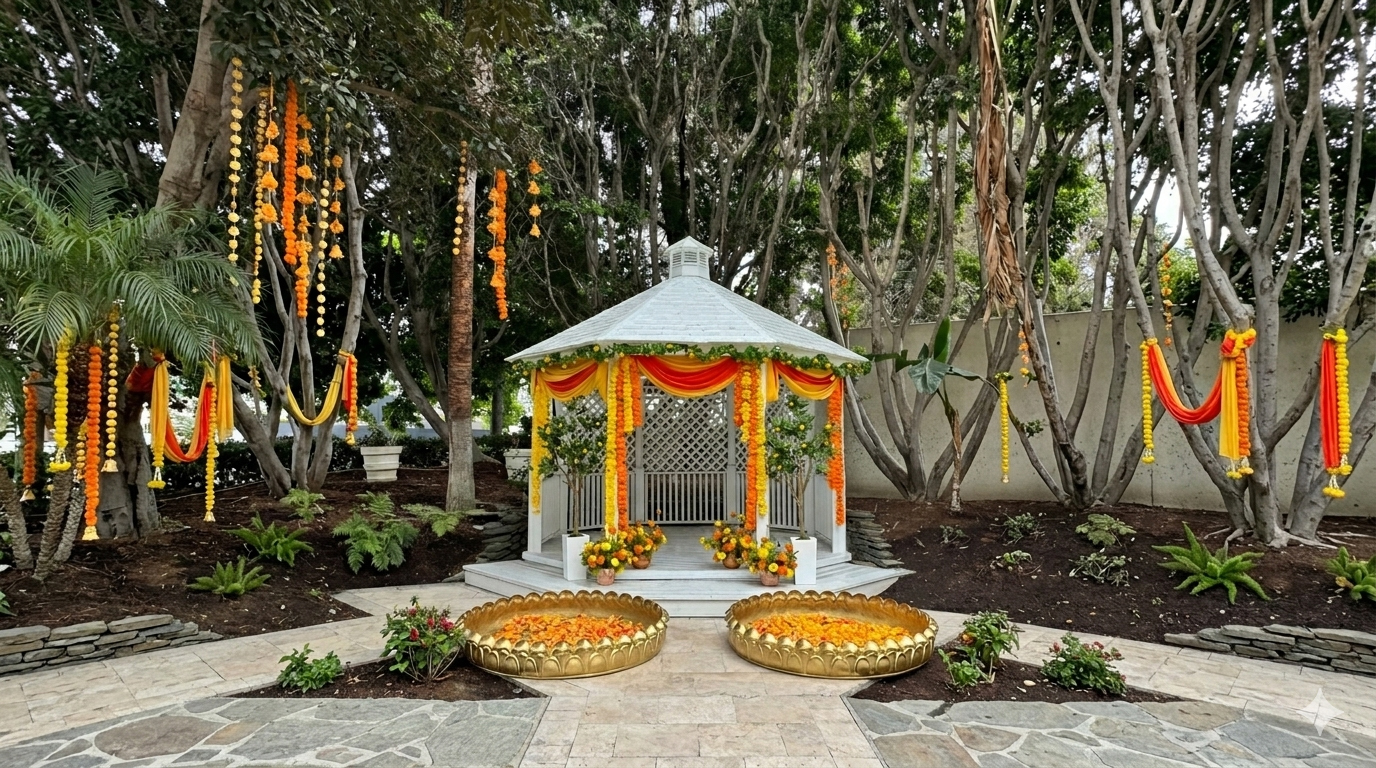
The Pre-Wedding Celebrations That Steal the Show
Here’s a pattern we see constantly at our Anaheim studio: couples planning a South Asian wedding pour months of design energy into the ceremony and the reception, then almost as an afterthought mention, “Oh, and we’re doing a Mehndi and a Haldi too. Can you handle those?”
We get it. The ceremony has the mandap. The reception has the grand reveal. Those feel like the headline events. But here’s what experienced families and designers already know: the Mehndi and Haldi are often where the wedding’s actual personality shows up. They’re more relaxed, more colorful, more playful, and increasingly, they’re the most photographed celebrations of the entire multi-day affair.
So if you’re planning a South Asian wedding, these pre-wedding events deserve real creative attention, not whatever’s left over from the ceremony budget. Let’s talk about how to design them well.
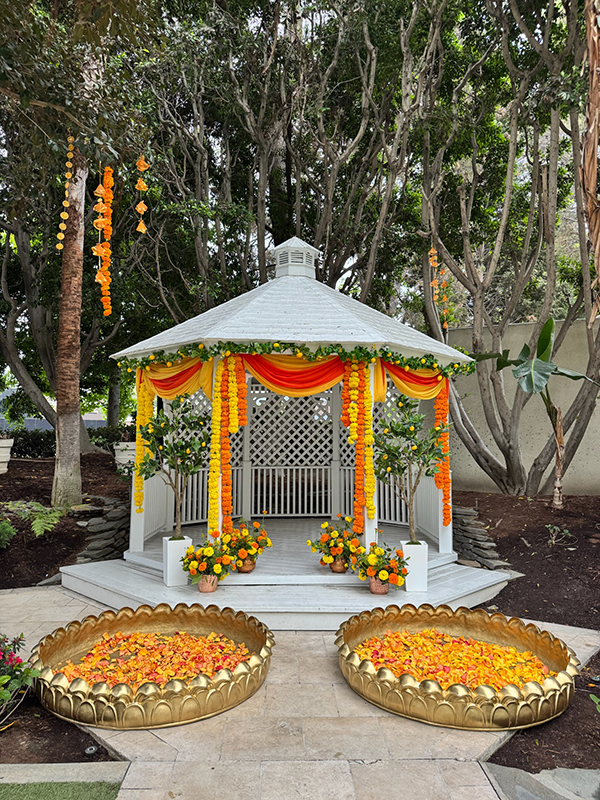
Where the Color, Laughter, and Real Celebration Begin
The Mehndi and Haldi share something most Western pre-wedding events don’t: they’re deeply participatory. Guests aren’t sitting politely watching a couple from a distance. They’re applying henna, smearing turmeric, singing, dancing, and getting genuinely involved. That single fact changes how you design the space. You’re not building a stage for people to look at. You’re building an environment for people to move through, gather in, and play.
That participatory energy is the design brief. Almost everything else follows from it.
Understanding Mehndi and Haldi: Two Celebrations, Two Moods
Before getting into design specifics, it helps to understand what these events actually are, because they call for genuinely different aesthetics.
The Mehndi
The Mehndi (sometimes Mehendi) ceremony centers on the application of henna to the bride’s hands and feet, usually extended to other women in the family and the wedding party. It’s traditionally an evening event: social, festive, full of music and dancing. The henna itself carries deep meaning that goes back thousands of years. According to the Natural History Museum, henna has been a symbol of joy across cultures and religions for millennia, used to celebrate weddings and festivals and believed to bestow good health and good fortune on the couple.
Design-wise, the Mehndi leans rich and saturated. Think jewel tones, intricate pattern, warm and glowing light, layered textiles, and comfortable seating that invites people to settle in for a few hours while the henna is applied and dries.
The Haldi
The Haldi ceremony is different in tone entirely. A turmeric-based paste is applied to the bride and groom, traditionally in the morning, as a blessing for purification, protection, and a natural glow before the wedding. It’s playful, often a little messy, and unapologetically yellow. Turmeric has been valued in South Asian tradition for centuries; the National Center for Complementary and Integrative Health notes turmeric’s long history of traditional use, which is part of why it sits at the literal and symbolic heart of this ritual.
Design-wise, the Haldi is bright, sunny, and informal. Marigolds, daylight, vivid yellows and oranges, and a setup that can cheerfully handle turmeric flying in every direction.
Designing the Mehndi: Richness, Texture, and Intimate Energy
The Mehndi is where you get to lean fully into color and texture. Because guests are seated for a while and the energy is intimate and social, this is the event that rewards layered, immersive design.
Low, comfortable seating. Floor seating with bolsters, cushions, and low tables is traditional and practical, creating that relaxed, grounded feeling. Mixed with a few lounge groupings for guests who prefer a chair, you get a space that encourages people to linger rather than stand around.
Textiles and draping. This is the event where bold fabric really shines. Vibrant drapes, patterned textiles, hanging dupattas, and layered fabric ceilings transform even a plain venue into something that feels transportive. Texture does a lot of the emotional work here.
A henna station as a focal point. Since the henna application is the centerpiece of the event, designing a beautiful seat or small stage for the bride (and her henna artist) gives the celebration a natural focal point and a gorgeous photo moment.
Warm, layered lighting. String lights, lanterns, candles, and warm uplighting create the golden, festive glow that makes an evening Mehndi feel magical. Lighting is one of the most underrated tools for setting this particular mood.
Florals with personality. Marigold strings, hanging floral installations, and bold blooms reinforce the saturated palette. Our custom floral designs for a Mehndi tend to be some of the most colorful and expressive work we do all year.
Designing the Haldi: Yellow, Sunlight, and Joyful Mess
The Haldi asks for an almost opposite approach, and that contrast is exactly what makes a multi-day wedding feel dynamic rather than repetitive.
Embrace yellow, fully. This is the one event where leaning all the way into a single color isn’t just acceptable, it’s the point. Marigolds, yellow and orange florals, sunny drapes, and bright textiles all reinforce the turmeric’s vibrant hue.
Design for daylight. Because the Haldi typically happens in the morning or early afternoon, often outdoors, you’re designing for natural light rather than against it. Open-air setups, garden settings, and bright backdrops all photograph beautifully in that soft morning sun.
Plan for the mess (it’s part of the fun). Turmeric stains, and the paste travels much farther than anyone expects. Smart Haldi design accounts for this with washable surfaces, protective ground coverings styled to look intentional, and a thoughtfully defined “splash zone” so the playful chaos stays contained without dampening the energy.
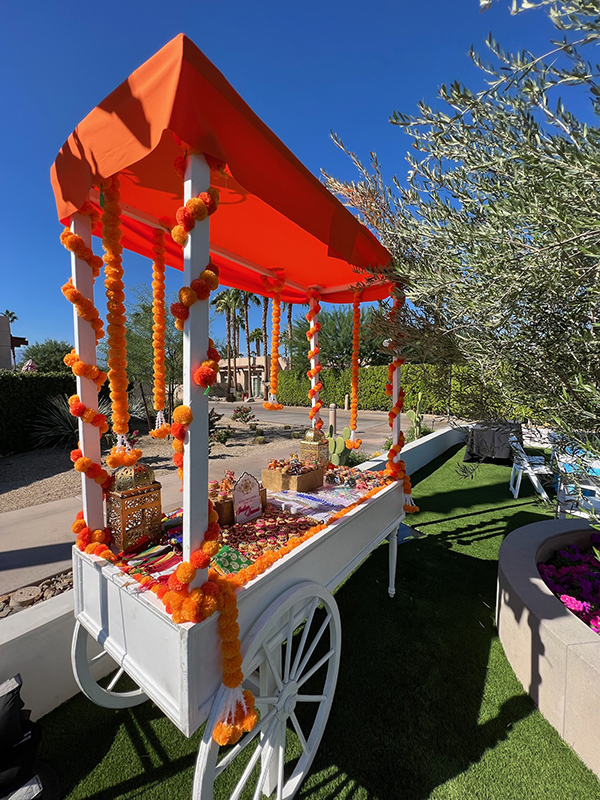
Playful, photogenic props. Decorative pots for the turmeric paste, floral-adorned umbrellas, hanging installations, and bright signage all add charm and give guests and photographers something to play with.
These Are the Most Photographed Events of the Weekend
Here’s something around half of our couples don’t fully anticipate: the Mehndi and Haldi often generate more shared photos and video than the ceremony itself. They’re relaxed, they’re colorful, and the participatory energy produces genuine candid moments that people can’t stop capturing.
That makes design-for-the-camera a real consideration. A few things we keep in mind:
Oversized floral installations and bold backdrops read dramatically on camera and become the natural gathering spot for group photos. Saturated color against a cleaner neutral backdrop pops far more than busy-on-busy. For the Haldi specifically, designing around natural light rather than fighting it produces those luminous, glowing images everyone wants. And a single strong focal installation, the kind of thing that makes someone stop scrolling, is often worth more than spreading the budget thin across lots of small touches.
Regional and Cultural Variations Worth Honoring
One thing we never assume: that every family does these events the same way. The Mehndi and Haldi go by different names and carry different specific customs across regions and communities. Bengali families may celebrate a Gaye Holud. Gujarati families have the Pithi. Pakistani families may hold a Mayun and apply an ubtan. South Indian traditions have their own distinct approaches and timing.
These aren’t just naming differences. They affect the appropriate colors, the structure of the event, the rituals involved, and therefore the design. This is exactly why we start by asking rather than assuming, an approach we go deeper on in our overview of the beautiful diversity behind South Asian weddings. Getting these details right is how a design honors a specific family’s heritage rather than treating cultural elements as generic decoration.
Where Mehndi and Haldi Fit in Your Overall Wedding Design
The best multi-day weddings feel cohesive without being repetitive. Each event has its own distinct mood, but a shared design language ties everything together so the whole celebration feels like one connected story.
Often that means a deliberate color progression across the events: saturated jewel tones at the Mehndi, bright sunny yellows at the Haldi, building toward the ceremony and reception palettes. The florals evolve. The lighting shifts. But everything clearly belongs to the same wedding.
A practical note on budget: don’t treat the Mehndi and Haldi as afterthoughts, but do scale them appropriately. These events are typically more relaxed than the ceremony and reception, so the design can be expressive and high-impact without matching the formal investment of the main day. Smart allocation here often means one or two bold, photogenic statement moments per event rather than blanket coverage.
As a full-service event design and decor company, we handle the florals, draping, lighting, rentals, and overall design across every event in your wedding, working alongside your planner (or one of the specialized South Asian planners we collaborate with) to keep the logistics and the aesthetics perfectly aligned. You can see more of this approach on our dedicated Indian and South Asian wedding design page.
Bringing Your Pre-Wedding Celebrations to Life
The Mehndi and Haldi are pure joy to design, because they’re where the celebration loosens up and the color comes out to play. From our Anaheim location, we design these celebrations for families throughout Orange County, Los Angeles, and across Southern California, bringing both design expertise and genuine cultural sensitivity to events that deserve both.
Planning your South Asian wedding and want a design team that treats every event, not just the big day, as something special? Contact 2Create Designs for a complimentary consultation. Explore our wedding gallery to see how we bring color and life to celebrations across South Asian traditions.